
I am going to preface this by saying I am not a vet. I had a deformed lamb this year and I wanted to share what I have learned. I am also going to warn you that there are pictures of the deformed lamb. Please come back tomorrow for cute lamb photos if that is more your style!
Until I had a deformed lamb last week, I did not know there were plants that can be ingested in early gestation that cause debilitating deformities. Even more interesting is that the plants can cause different deformities depending on when the plant is ingested.
Star had a set of twins, one lamb was normal looking and the other had obvious problems with the mouth and nose. The best description I could come up with was, a nose like a bulldog. It looked like everything was mushed in. Unfortunately, she could not eat. Even if she was able to nurse, I was concerned about her eating abilities in the future.
I am not someone to just say, oh well. I wanted to know ‘what’ caused this deformity. I looked up ‘lower head deformity in sheep’ on the internet and found ‘Monkey Faced Lamb Syndrome’ along with this picture of a goat kid.
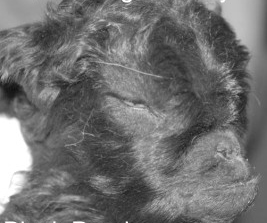
It is more severe, but our lamb sure looks similar…
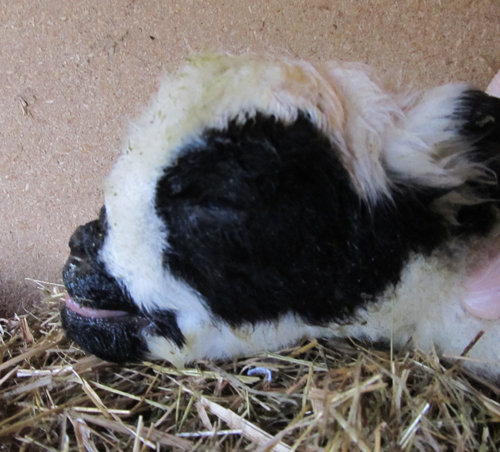
It is not uncommon for one lamb to be affected and the other to be fine.
This particular deformity is caused by the sheep eating CornLilly (False hellebore) which grows wild throughout the Western US. The unusual thing about this particular plant is that depending on which day of pregnancy it is ingested, is what causes the different degenerations of the fetus. Ingestion of the plant on day 14 of gestation causes ‘The Monkey Faced Syndrome’ – lack of nasal cavity, sometimes also a cycloptic situation (one central or offset eye instead of a pair of eyes). Ingestion on the 19th to the 21st day of gestation will give higher chances of cycloptic involvement as well as forelimb deformity. Days 27 to 32 of gestation shows a marked shortening of forelimbs. Tracheal defects (lateral flattening of the trachea throughout its entire length) when eaten on days 31-33 of gestation. The difficult thing about this poisoning is that many times the sheep does not show much in the way of outward symptoms of poisoning. Therefore, this can be quite a shock when the lamb is born with the defects.
I talked to my vet and he said that we may never know what caused this. He said that flukey things happen and he doesn’t start looking for a cause until there are more than 2 deformities in a lambing season. Since this was the last set of lambs for the season, I will be keeping my eyes open for any suspicious looking plants in the pasture this Fall.

 Stories from the Farm